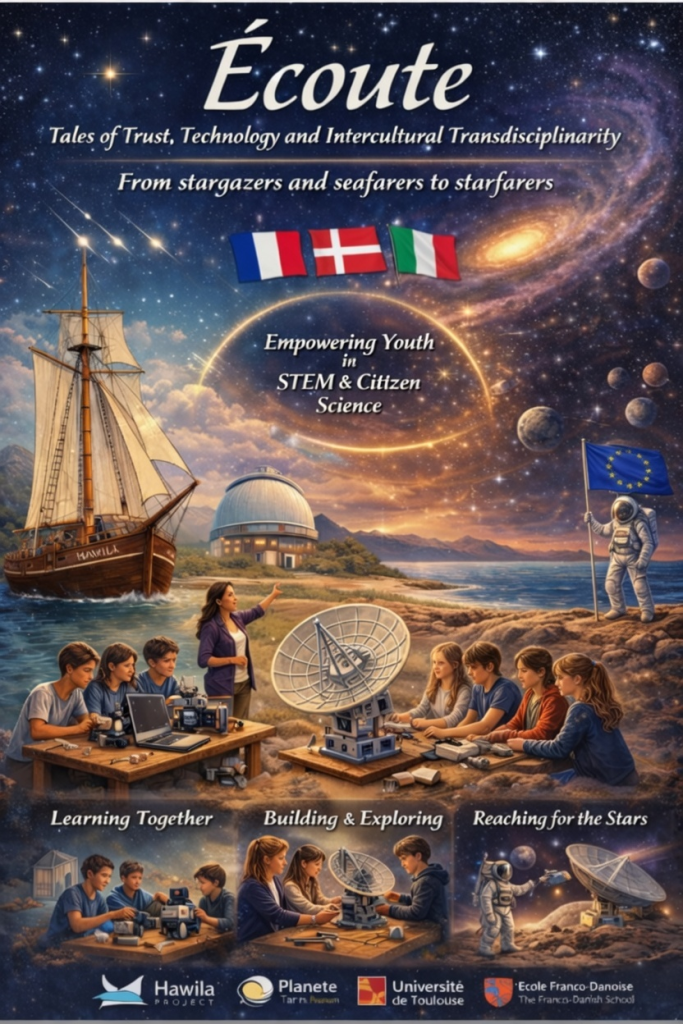
From stargazers and seafarers to starfarers
Empowerment and well-being (in Danish: “myndiggørelse og trivsel”) often go hand in hand. Be it in the form of the motivation fostered by success experiences, the noble pleasure of understanding something difficult, the inspiration gained from trying something new, the satisfaction of having built something beautiful or the sense of belonging when being part of a team aiming for a common future.
The project ‘Écoute’ is a three-year project aiming at empowering youth both socially and academically by introducing a new transdisciplinary, immersive STEM teaching didactic in France and Italy through an evolving network of partner schools and institutions. Écoute has a dual meaning in French – meaning both “listen” and “sail sheet”, expressing both “attention” and “agency”. The didactic, originally developed by The Franco-Danish School and the Niels Bohr Institute in Copenhagen, consists of teaching algebra as a natural language, while illustrating and motivating the subject matter by hands-on activities such as 3D design and printing, robotics, programming, AI, astronomy and woodworking. The teaching is done in project groups, promoting the perception of others as valuable partners, not competitors, eventually nurturing trust, honesty, “tryghed” (Danish for “psychological safety”) and an action-oriented mindset. The partner network of schools would be built gradually through face-to-face interactions during workshops, internships and larger gatherings.
The purpose would be to introduce children to STEM as a creative, collaborative and curiosity-driven language for understanding and shaping the world, fostering transversal skills such as critical thinking, problem-solving, creativity, and teamwork, while enhancing motivation for education and active participation in the green and digital transitions. One particular activity would consist of building a radio telescope using 3D printed elements and a novel assembly technique – synchrokinesis – as described in [1] and be part of a network of radio astronomy-capable schools collaboratively searching for cosmic radio signals. This citizen science component connects young participants directly to real scientific research, building a sense of global belonging, scientific agency, and responsibility as capable citizens contributing to knowledge creation.
Dissemination would be the principal component of the project and be done through the workshops, by releasing the teaching material online, as well as participating in larger gatherings such as the inventors’ conference Concours Lépine in Paris (400000+ visitors) and the Maker Faire Rome (100000+ visitors). Internships aboard the Hawila, at The Franco-Danish School and at Planète Tarn would contribute to continuously upskilling the teacher workforce.
Evaluation of the project would be done by a combination of pre- and post-activity surveys measuring changes in STEM motivation, self-efficacy, and transversal skill development; qualitative feedback from participants, teachers, and facilitators; tracking of long-term engagement (e.g., continued participation in STEM activities or citizen science networks); and participatory assessments to ensure inclusive impact, particularly for at-risk youth from diverse socio-economic and cultural backgrounds. The network of radio telescopes across Europe, and possibly beyond, would be a lasting and growing testimony to the success of the project.
Partners:
Hawila Project:
Planète Tarn
Université de Toulouse / ISAE Supaéro
The Franco-Danish School
[1] Guilbert, Alix et al., A 3d printed synchrokinetic telescope, AIAA Ascend 2026